Friday, 9 April 2021

Doosron ki jai se pehle, khud ko jai karen: Jaya Bachchan (nee Bhaduri) turns 73


The year was 1971.  I had barely stepped into my teens and was an avid reader of Filmfare/Femina/The Illustrated Weekly of India. That was the year when Hrishikesh Mukherjee’s Guddi released and Jaya Bhaduri made her debut as Kusum, the quintessential schoolgirl with a massive crush on filmstar Dharmendra. She must have been about 22 then, but looked absolutely convincing as the teenaged, school-going Kusum in her pleated uniform, white blouse, white keds and hair tied up in plaits, complete with white ribbons. Unbelievably, (or looking back, perhaps predictably) her fresh-faced appearance, devoid of the pancake, the bouffant hairdos, the flouncy, body-hugging, revealing dresses, dramatic eye makeup and exaggerated dialogue-delivery, took the nation by storm. In retrospect, it seems we were ready – for the change. Sure, the script demanded it. But then, even the script was path-breaking. The school prayer which is going on when she comes on screen (Humko man ki shakti dena) became an anthem of sorts. Still is – the title of this post is borrowed from the second line of the prayer song. 


Forever Kusum: The eternal schoolgirl, Jaya in Guddi


Autograph please: With Dharmendra playing himself


The Camera Loved Her: In her (almost) first shot in 'Guddi'


Full of vigour and idealism, she followed it up with Upahaar (1971) Koshish, Parichay, Bawarchi, Ek Nazar, Piya ka Ghar, Annadata, Bansi Birju, Anamika  (1972), Zanjeer and Abhimaan (1973) Kora Kagaz, Naya Din Nayi Raat (1974) Mili, Sholay and Chupke Chupke (1975), a spate of films that had her portraying believable characters with a degree of convincing realism that was unusual for the times. In many of these, she was pitted against older, more experienced actors, far more successful than herself.  Most times, not only did she hold her own, but also managed to attract attention to herself. Within a few years, she carved a niche for herself which has remained uniquely hers to this day.


With Anil Dhawan in Piya ka Ghar:  A film on the  urban housing problem  


With Sanjeev Kumar in Koshish: Playing a speech and hearing- impaired couple 


With Kamini Kaushal in Upahaar: Based on Tagore's Samapti


Baahon mein chale aao from Anamika: The one-of-a-kind bedroom song


Bawarchi: Holding her own in a stellar cast of veterans


The Young Widow in Sholay: The silent love story between Jai and Radha 


With Jeetendra in Parichay: The Hindi adaptation of The Sound of Music


With Randhir Kapoor: A rare glamorous avataar in Jawani Diwani 


With Vijay Anand in Kora Kagaz: A remake of Saat Paake Bandha


Mili: The girl suffering from a fatal disease who becomes an an inspiration


However, few people know that the cinematic journey which began with Guddi on the Hindi screen actually began with Mahanagar made in her native Bengali by Satyajit Ray. She was actually 15 then (the age she portrayed in Guddi) and played the role of Bani, the lead character Subroto’s (played by veteran Bengali star actor, Anil Chatterjee) sister.  The film also had Madhabi Mukherjee (a big name in Bengali films and Ray’s Charulata) in the cast. She landed the role courtesy family friends who suggested her name to Ray. 


In Satyajit Ray's Mahanagar: At age 15


Mahanagar: With  co-stars Anil Chatterjee and Madhabi Mukherjee


She enjoyed the experience a lot and became an avid watcher of international films at the local film society, often discussing story, characterisations and actors portrayals with family members. 


Jaya's Parents: Tarun Kumar and Indira Bhaduri 


Once when her father (the renowned journalist Tarun Kumar Bhaduri) remarked that a certain actor could have turned in a better portrayal had he been better trained, she was intrigued to learn that there were actually schools/institutes where one could train and learn acting as a craft. Her mind was made up. She was going to join FTII – and in that moment the child actor of Mahanagar, was destined to become the Jaya Bhaduri the world knows today. She passed out with a first class first being a gold medallist in her batch (Asrani, Paintal, Anil Dhawan, Danny Denzongpa, Navin Nishchal were classmates) and path blazer (and was later the external examiner in practicals for Shabana Azmi and Zarina Wahaab, her juniors).  The former in fact admits to taking up acting as a career after watching Suman, a documentary with Jaya playing Suman as part of her training at the FTII).


With friends from the FTII: (From the left) Shabana, Romesh Sharma and Danny


Her acting guru Roshan Taneja in his memoirs (Moments of Truth: My Life with Acting) recalls how in 1968, she got selected into the acting course at the institute. Her application, under 'Previous Theatre/Cinema Experience,' listed her stint with Ray in Mahanagar, so the entire selection panel was curious to see the candidate. When she was called in, they discussed her experience of what it was to work with the great master. Then they asked her to perform the acting piece assigned to her. But perhaps “wishing to make a better impression” she decided to perform something she had prepared on her own. “She entered with the dead body of a child in her spread-out arms, and with it she, ever so slowly, moved around the room, making us witness a loving mother’s deeply moving, sorrowful lamentation. She made up for many a dry patch we had endured during the period of audition with her performance.” (Shades of Hazaar Chaurasi ki Ma?)


With acting guru Roshan Taneja (in glasses) and fellow-student Shatrughan Sinha


He also recalls how she got an offer from the acclaimed Bengali director Mrinal Sen to play the lead in Bhuvan Shome (opposite thespian Utpal Dutt, in his younger days) while still studying at the FTII. Sen even offered to shoot it during the summer holidays so her schedule/classes would not be upset. But much to her disappointment, the rules of the Institute barred students from taking up any professional assignments, even during vacations, until they had completed the course. She rued the rules and criticised the principal’s strict stand on the issue, but all to no avail. The Principal (Mr Jagat Murari, in those days) told her she was free to leave the Institute at any time she wanted, if the film was so important to her – that perhaps made her take a more balanced view of the whole thing. But just goes to show how her fame had travelled, even while she was still training as an actor.  


The Missed Opportunity?: Suhasini Mulay with Utpal Dutt in Bhuvan Shome


No article on Jaya Bhaduri can ever be complete without mention of her lesser-half, megastar Amitabh Bachchan. It was at FTII that she first met him – he had come to the Institute as part of KA Abbas’ cast in Saat Hindustani to shoot there. “All of us were very impressed on learning from Abbas that the kurta-clad young man was the son of the great poet, Harivansh Rai Bachchan” she narrates. “But he used to look so lean and thin those days, the talk soon veered around to ‘Inko khaana-vaana dete hain ya nahin? Dubla patla sa hai, actor banne aaya hai…kaise banega?’  Everyone wondered if he was star material in an industry ruled by actors like Dharmendra.” But to my eyes, he looked very distinguished even at 20 years old, and somehow left no doubt in my mind that he had it in him,” she says. Their friendship grew.  He would visit her off and on at the FTII. 


Once Upon a Time: Jaya and Amitabh from her Days at FTII 


Eventually, Jaya passed out with flying colours and made it big in Hindi movies. Occasionally, he would bump into her on his rounds of studios as a struggling actor, where he would come scouting for work.  


There came the day Prakash Mehra signed him as the lead for Zanjeer on the recommendation of script writers Salim-Javed, for a script that had been rejected by the likes of Dev Anand, Dharmendra, Raj Kumar…the list was endless. When Jaya was offered the lead role opposite him, she signed without hesitation, sharing the script-writers’ conviction that this was a role that was going to make him.  Before that, she had co-starred with him in Ek Nazar and Bansi Birju, both of which had flopped at the box-office. After Zanjeer was shot, Mehra found it difficult to find distributors. Eventually, it was released as a B-grade action film.  And in the words of a popular film columnist, “At twelve noon on the day of the release Amitabh Bachchan was a nobody, at three pm he was a star and at six pm Amitabh Bachchan had replaced Rajesh Khanna as the next superstar and there was no stopping him……


With Amitabh in ZanjeerThe Film that Made Amitabh Bachchan


With Amitabh in Abhimaan: When reel-life overlapped real-life?


Jaya and Amitabh married soon after in 1973, (parts of Abhimaan, were shot after their marriage). Two children were born to them, Shweta and Abhishek; Shweta is the daughter-in-law of Ritu Nanda (sister of Rishi and Randhir Kapoor) and a published author (Paradise Towers) while Abhishek is a leading film actor in his own right, married to Miss World 1994, Aishwarya Rai, also a movie star. Together, the family is regarded as film royalty and accorded great respect wherever they go.


At their Wedding in 1973: A Marriage that Endures


The First Family of Bollywood


Jaya gave up working in the movies for a time while the children were growing up, but has continued to work off and on ever since (Fiza, Silsila, Kabhi Khushi Kabhi Gham, Kal Ho Na Ho, Hazaar Chaurasi ki Ma, a Marathi film Akka and one in Bhojpuri, Gangadevi besides Desh, Meherjaan, Sunglass in Bengali, to name a few). She also made a career for herself in politics first elected in 2004 as a Samajwadi Party MP to the Rajya Sabha. She was re-elected in 2012, 2018 and continues to represent SP in the RS in great style and elan in 2021.


In Fiza: Playing Mother to Hritik Roshan and Karishma Kapoor


In 'Silsila': The Greatest Casting Coup in Hindi Film History


In her long and notable career, Jaya has been awarded 9 Filmfare awards for Best Actress/Best Supporting Actress, Filmfare's Lifetime Achievement Award and a Padma Shri in 1992.

In the nineties, she set up her own  production house Saraswati Audio Visuals Pvt Ltd which produced 65 episodes of an entertaining sitcom Dekh Bhai Dekh that was created, written, directed by Anand Mahendroo.  It told the story of three generations of the Diwan family that live together and are part of each other's trials and tribulations.  It starred a galaxy of India's cinematic and television talent, such as Divya Seth, Navin Nischal (a gold medallist like Jaya herself, from the FTII), Farida Jalal, Shekhar Suman, Bhavna Balsaver, Deven Bhojani, Vishal and Nattasha Singh.    

Leftrightthodasacenter.blogspot.com wishes her many happy returns of the day! You can leave your best wishes in the comment section below. And as always, do not forget to read, share, follow and subscribe!    


Image credits: Google


Sunday, 4 April 2021

Aane se uske aaye bahaar!


On the 7th of April, we celebrate the 79th birthday of an evergreen actor, who has spent 40 decades in the Hindi film industry and is still going strong.  Jeetendra.  He is a superstar of Hindi films, who has been reigning on the hearts of moviegoers since the 60s. Brought up in a chawl in Mumbai’s Girgaum, he now lives in Krishna, a palatial four-storey house in Juhu a luxurious suburb of the city -- his is truly a story of rags to riches, scripted straight out of the films he made a name for himself in.


At two years old


With his brother Prasann and mother, Krishna Kapoor


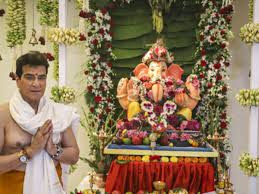
Born Ravi Kapoor in Amritsar in 1942, Jeetendra’s parents migrated to Mumbai when he was an infant about twenty days old.  They lived in Shyam Sadan chawl in Girgaum that housed 80 other families until 1959, when he was 18.  He recalls the days when he would run to fill bath water in drums from the single municipality tap in the tenement building, whenever there was water.  “Those were the best days of my life. Small things like this gave so much joy, which today even big things cannot. We used to live for the 11 days of the Ganpati festival. The puja, the dancing, the festivities…I still go there to do Ganpati sthapna and personally perform the puja every year,” he smiles. He firmly believes that one’s surroundings play a very crucial role in their upbringing and values.  “To the world, I might be a superstar. But in my heart, I am a typical lower middle-class Maharashtrian -- in language, in culture, in habits, everything. “In fact, I became a hero because I could speak the language so well. Growing up, we imbibed this way of life, these moral values and they will go with me to my grave.” he says.   


Revisiting his old home at Girgaum
                                                    

Conducting Ganesh Puja at Shyam Sadan

                    
"Krishna": Jeetendra's bungalow at Juhu, Mumbai


Going back to his roots, he narrates how his father and uncle owned a costume/imitation jewellery shop which supplied these as accessories to films. As a teenager, he recalls doing the rounds of studios after school with his uncle, carrying bags of artificial jewellery for the artistes to their make-up rooms.  When his uncle was too busy, he would carry the boxes alone. It was the year 1959. Doing the daily rounds one day, he happened to land at Filmalaya Studios, where director V. Shantaram was filming Navrang. He tried to go on to the sets to watch the shooting, but wasn’t allowed.  In the evening at dinner, he complained to his uncle about not being allowed on the sets.  His uncle spoke to people at the studio, trying to wangle permission. They were told that the only way one could get on to Shantaram’s sets was by working on them, and that there were auditions going on for a prince’s role.  He was more than willing. “That day, instead of travelling by bus, I spent all my pocket money and took a taxi to the studio. When I got there, I found there were 200 princes all waiting to be auditioned. They were shooting the song, “Tu chhupi hai kahaan….if you look closely, you can still spot me in the crowd.  And that’s how I got cast in a bit role in my first film,” he remembers.    


Time passed.  In 1963, his dad fell ill and financially things took a downturn. Being the eldest in the family, he felt the pressure of fending for the family. Not having done well at college, he had no degree to fall back upon. “I thought of going back to the studios. To my mind, this was the only well-paying job that did not need any qualification.” He returned to Rajkamal Studios and met Anna (V. Shantaram) again, asking him for a job. Shantaram had no opening for him right then, but told him he would keep him in mind.  And he kept his word.  One day, Ravi (he wasn’t Jeetendra until then) got a call from the studio; Anna had found just the part for him. He was cast as the heroine, legendary actress, Sandhya’s body double.  When we see their pictures, we can understand why!  Later, he played bit roles in the film too.


When he was Ravi Kapoor


Sandhya: Navrang's lead actress


Playing Sandhya's body double in this song   


Portions of the film were shot on location at Bikaner, in Rajasthan.
 He learnt discipline there, getting thrown off the sets for late-coming. He got back into Anna's good books by turning up punctually the next day in full costume. He remembers needing 25 retakes for saying the line, “Sardar, dushman tiddiyon ke dal ki tarah aage badhta hi aa raha hai” and finally bursting into tears, when he still didn’t get the words right. On the 26th retake, Shantaram okayed the shot, even though he stammered and mispronounced, “tiddiyon” in that take too.  “I can never forget my Annasaheb and his technical crew…they gave an irresponsible, raw, half-educated, total duffer like me the second chance I didn’t deserve.   I owe my entire career to Rajkamal … if it had not been for them, no one would have heard of me.”


V. Shantaram  -- A Legend in Marathi Cinema
His first lead role in Geet Gaya Patharon Ne opposite Rajshree 

In 1964, Shantaram cast him as the lead hero opposite his own daughter Rajshree in Geet Gaya Patharon Ne, her first adult role in a Hindi film. He was given the screen name of Jeetendra Kapoor, which eventually got shortened to just Jeetendra.  The film didn’t do too badly, but it didn’t bring him any good offers.  He continued to audition for roles, getting help with his dialogues and expressions from his classmate from St. Sebastian Goan English School, Rajesh Khanna, who was into full-time theatre.  Soon he hit big time as the singing dancing spy in Farz, (opposite Babita, mother of Karishma and Kareena Kapoor) in 1967. His Mast baharon ka mein aashiq track from the film with his self-chosen all-white costume and shoes became his trademark. It earned him the sobriquet of “Jumping Jack Jeetendra” in the film press, which has stuck to him ever since.

In Farz:  A Star is Born


In his iconic white outfit and shoes
                                                       

Farz proved to be the turning point, after which there was no looking back. Whatever he lacked in histrionics, he made up for with his hard work and reliability at the box-office. He practically lived on the sets, practicing his lines, his dance moves with or without his co-stars, and whether it was running around trees (Tumhari Kasam, Ek Hi Bhool, Mawaali), singing songs (Banphool, Humjoli, Jigri Dost, Caravan, Himmatwala, Justice Chaudhary, Tohfa, Lok Parlok) or playing serious characters (Jeene ki Raah, Parichay, Khushboo, Dulhan, Kinara, Meri Awaz Suno, Chhup, Bidaai, Badalte Rishtey, Aasha) or doing old man leading roles (Udhaar Ki Zindagi, Santaan, Pyasa Saawan), Jeetendra has always proved himself as an excellent bankable star material, whom audiences have showered abundantly with their love and appreciation down the years.  


The trademark song and dance routines that made him the darling of his audiences

In Maqsad with Sridevi


With Sridevi again, in Himmatwala


In Justice Chaudhry


With lemons rolling down the hillside


He is the only Indian actor to have appeared as a hero in nearly 200 films, repeatedly costarring with the biggest heroines of his time, such as Rekha, Hema Malini, Reena Roy, Sridevi and Jaya Prada.


In the 70s and 80s when first Rajesh Khanna and later Amitabh Bachchan ruled the roost, Jeetendra moved to the South and starred in Hindi films that were remakes of major hits in the south. Directors like K. Raghavendra Rao (Nishana, Farz Aur Kanoon, Himmatwala, Justice Chaudhury, Jaani Dost, Tohfa, Mera Saathi, Hoshiyar, Suhagan and Dharm Adhikari), K. Bappiah (Dildaar, Dil Aur Deewaar, Takkar, Mawaali, Pataal Bhairavi, Maqsad, Ghar Sansar, Majaal, Swarg Se Sunder) and T. Rama Rao (Lok Parlok, Judaai, Ek Hi Bhool, Yeh Desh, Maang Bharo Sajna, Dosti Dushmani, Insaf Ki Pukar) delivered blockbuster hits with him in the main lead. It is said that these producers signed him for 2 to 3 films at one time and payment to Jeetendra was made for each film at half the market rate of Rajesh Khanna and Amitabh Bachchan.  But as he signed more films than them, his earnings did not suffer.


Those days, he would see his wife and children only on the weekends. His wife Shobha whom he married in 1974, after Bidaai became a superhit, would pick up their children Tusshar and Ekta, every Friday from school, and they would board the flight to Madras/Hyderabad, returning on Sunday night. Looking back, he says had it not been for these weekend visits, he would never have kept in touch with his children during their growing up years at all.


With his children, Ekta and Tusshar

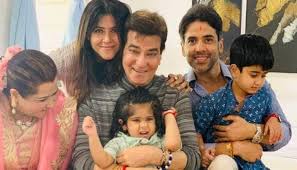
Today, in semi-retirement, he spends most of his time with his grandchildren, Laksshya and Ravie Kapoor, both born out of surrogacy. “I am making up for lost time – reliving my children’s’ childhood which I could never be part of, by watching my grandchildren grow up."


With Tusshar, Ekta and their children, Laksshya and Ravie, and his wife Shobha (extreme left)


Of his children, Tusshar who studied abroad, followed in his father’s footsteps and joined Hindi films. He’s had a reasonably successful career. But the real surprise has been his daughter, Ekta Kapoor, who at the age of 19 made a foray into the world of television by producing her own serial, and by age 26, was running her own production company, Balaji Telefilms, with her mother Shobha Kapoor. She has been the producer of several leading television serials and has produced several hit films too, such as The Dirty Picture, Lipstick Under My Burqa, Once Upon a Time in Mumbai and has launched stars like Vidya Balan, Ram Kapoor, Rajiv Khandelwal, Ronit Roy, Prachi Desai and Sushant Singh Rajput. She has recently announced Goodbye, with Amitabh Bachchan and Rashmika Mandanna (a prominent actress of Telugu and Kannada films). They will play a father-daughter duo. Directed by Vikas Bahl, the film is co-produced by Reliance Entertainment and Balaji Telefilms. The film has gone on the floors with shooting commencing on April 2, 2020.


Cast of "Goodbye": Amitabh Bachchan and Rashmika Mandanna


In his long innings, Jeetendra, never got his due as a huge star. The English language film press always looked down upon “Jumping Jack Jeetu” with his tight white trousers and shiny white shoes and boisterous dance moves.
 No one looked at Jeetendra as a star who commanded his own audience irrespective of whether it was Rajesh Khanna or Amitabh Bachchan, who was the ruling superstar. He has had a better hit rate than most of his contemporaries, and continues to remain at the crease.


With his childhood friend, Rajesh Khanna


With Amitabh Bachchan


The ever-fit and totally disciplined Jeetendra, returned to acting in 2020 with a Web series titled Baarish (starring Sharman Joshi). Given the tie-up between Ekta Kapoor’s Alt Balaji and Zee5, Baarish will be seen on both platforms from April 2021.


In a long career spanning forty decades, major awards may have eluded him (barring Filmfare/Screen/Stardust/Guild’s Lifetime Achievement Awards), but Jeetendra does count as a living legend of Hindi cinema. A career that began largely as the result of being in the right place at the right time, was actively sustained through humility, discipline and dedication and learning hands-on. Quite obviously, he never took anything for granted.


You can post your birthday wishes in the comment section below -- and as always read, share, follow and subscribe lefrightthodasacenter.blogspot.com

Image credits: Google                                                                  Video credit: YouTube                                                                    Lead sketch of Jeetendra by Monica Saini