Showing posts with label Festivals of India. Show all posts

Monday, 12 April 2021

When India Celebrates Multiple New Years!


In a glorious example of unity in diversity, people of different Indian communities  all over the world celebrate their new year over the next few days, on April (13th/14th/15th). Bengalis would call it Poila Boishakh, Assamese Bihu, Punjabis Baisakhi, Sindhis  Cheti Chand, Malayalis Vishu, Maharastrians Gudi Padwa, Telegu and Kannada-speaking people would celebrate Ugadi,  Odia speakers Pana Sankranti and Tamil-speaking Indians Puthandu (the title pic is of Puthandu kolam in a Tamilian household).


Not for nothing is India known as the land of festivals.  When in India…a festival by any other name would be as …celebrated?  In general, this particular festival coincides with the first day of the Hindu calendar, so Happy New Year everyone!  Since the first month of the calendar is called Vaishakh (Baisakh/Boishak), the first day itself is called Vaishakhi or Baisakhi. (This falls around the 13th or 14th of April of the English calendar every year). Hence, the festival that falls on this first day of Vaishakh is called Vaishakhi (or, that’s right, Baisakhi).


All over India, it’s that time of the year when the fields are filled with golden crops, ripened and ready for harvesting. For the farmer, it’s the time to reap the hard-earned fruits (grains) of his labour.  India was (still is) a largely agrarian economy, so the day marks a time of plenty.  It’s also the season of spring, when Nature fills every bough and branch with flowers and fruits. Hence families celebrate the first day of Vaishakh as a day of thanksgiving: for the abundance of grains, fruits and flowers that Nature has blessed them with.


Although it’s called by many names, this is the common thread that runs through the celebration everywhere.  Householders clean up their homes, take a ritual bath/dip in the holy rivers, be it Ganga, Jhelum or Kaveri (this is the day when Ganga is believed to have descended from the heavens at the Brahma Kund in Haridwar) and worship their Gods, offering them the first of the fruits, flowers and grains that they have blessed the worshippers with (Malayali households make arrangements of flowers, fruits and grains and call their friends and relations to come over and admire the Vishukanni or “the lucky sight”).  People visit their temples or holy shrines, invite friends and family home to party, offering them gifts, to share in the abundance and splurge at fairs and festivities, giving alms to the needy. Wearing new clothes (puthukodi), lighting up fireworks and eating special goodies (jaggery and sattu in UP, fried gram cakes in Himachal, sadya a mix of sweet, salt, bitter and sour in Kerala, a drink called pana in Odisha which is a mix of wood apple, mango, jaggery and pepper, eating sweetened rice or tihri amongst the Sindhis). The whole ambience is one of gratitude and sharing the abundance.   
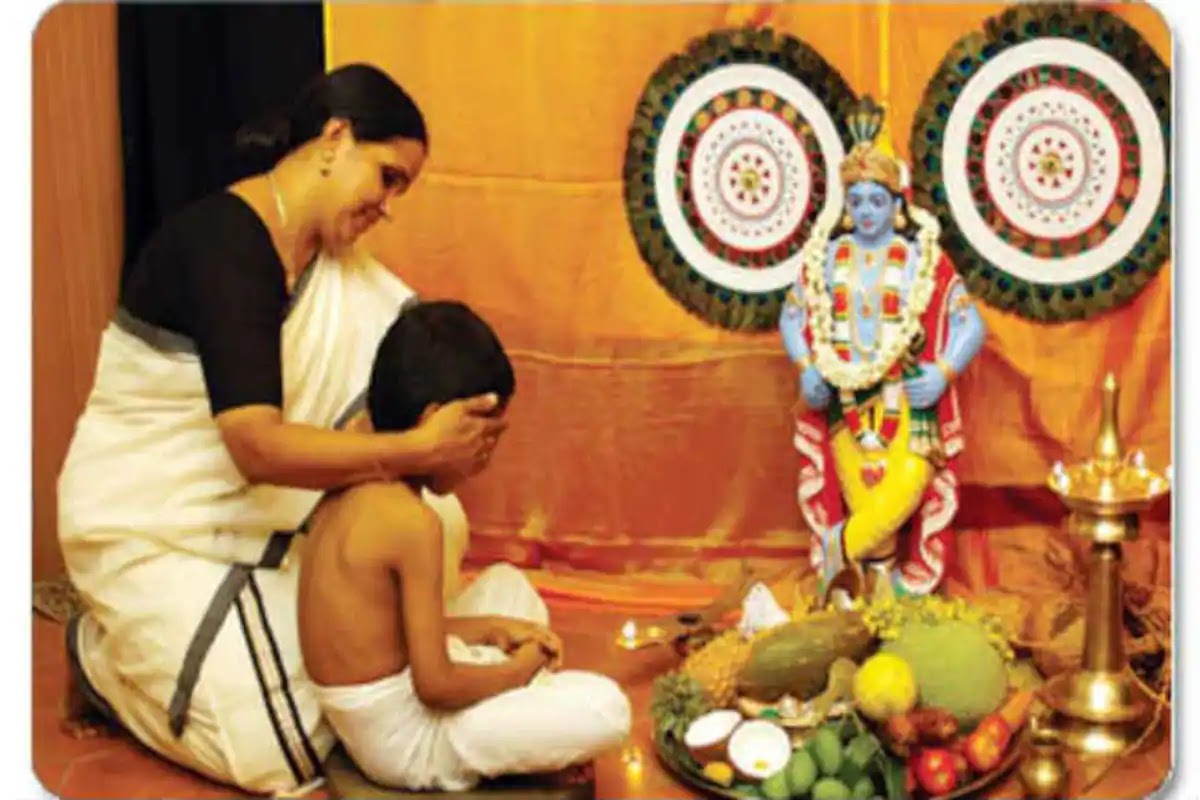

Vishu in Kerala: Vishnukani, the 'lucky sight' -- worshipping Lord Vishnu (in the form of Krishna) with an offering of the best of flowers, fruits and grains 


Pana Sankranti: On the right, the customary clay-pot with a small opening for water to drip over the Tulsi in the backyard, and on the right, a glass of pana, a cooling drink of wood apple (bel), mango juice, pepper and jaggery


In Maharashtra, as in Bengal, houses are cleaned up and floors decorated with intricate, colourful patterns called rangoli in Marathi and alpona in Bengali that echo the burst of colours in Spring.  Both in Maharashtra and Goa, womenfolk prepare special dishes that are mixture of sweet and bitter (gur, gul) with sour (tamarind) along with poori, shrikhand and/or puran poli.  For Ugadi celebrations in Karnataka and Andhra, a garland of bella and bevvu (mango and neem leaves) is hung over doorways, and special pacchadi (a dish of sweet, sour, salty and bitter ingredients) is prepared and eaten as a welcoming precursor of life’s sweet and bitter experiences in the year to come.


The Ugadi platter:  With mango, jaggery, chilli, tamarind and neem representing the tastes of life


The Gudi Padwa Rangoli in a Maharashtrian Home

In Assam and Bengal, everyone wears new clothes, worships Lord Ganesh and Goddess Lakshmi for prosperity with special offerings of sweets and gifts to mark the occasion.  It’s a time of family gatherings with lots of good food, when youngsters take the blessings of elders and everyone greets each other with ‘Shubho Nabobarsho’ (Happy New Year). In Assam particularly, Bihu is a time of much community singing and dancing to the beat of the drums.  


Poila Boishakh: Alpona on the passage floor


Street Alpona in Chittagong, Bangladesh


Shubho Naboborsho: Worshipping Ganesh and Lakshmi


Bohag Bihu: Dancing and singing in the customary white and red to the sound of drumbeats 


For the Sikh community, this day is of special historical significance as it marks the day of the coronation of Guru Gobind Singh as the ninth guru and the foundation of the Sikh/Khalsa community to protect Hindus and fight their persecution by the Mughal rulers to convert to Islam. In subsequent years, it was on this day that Ranjit Singh was proclaimed king of a unified Punjab to defy the British; it also marks the day of the Jallianwala massacre by General Dyer on a Baisakhi gathering. Gurudwaras and temples all over Punjab are decorated; people offer a drink of sweetened water cooled in earthen pitchers mixed with seasonal fruit, (called chabeel) at street corners. Community fairs and kirtans (congregational singing of hymns/holy songs) are organised. Wearing turbans and clothes of a bright yellow colour and eating foods coloured yellow (such as jalebis) is considered auspicious. The entire area around the Golden Temple is awash with a sea of yellow as Sikhs congregate in a festive mood to celebrate melas or fairs. Baisakhi is considered an auspicious day for getting married or starting any new ventures in business or education or otherwise.     


Baisakhi: Oye jatta aai Basakhi! 


However, the Gujarati and Rajasthani communities celebrate their new year called Bestu Varas closer towards Deepawali in October, whereas the Buddhists celebrate Losar in February. The Parsi New Year Navroz is celebrated in March, in July or in August, depending upon the calendars the particular section of the community follows.  Yes, you are right again...in India, New Year celebrations last the whole year!    


Over the next three days, even in far-off US, UK Canada, Australia, Srilanka, Nepal, Bangladesh and in parts of the Far East, people of Indian origin will celebrate the many forms of Vaisakhi as a day of thanksgiving, festivities and togetherness and of new beginnings, with friends and family in attendance.  


Leftrightthodasacenter.blogspot.com wishes all Indian communities across the globe a most warm, prosperous and happy new year (but do be mindful of your masks and social distancing!) As always leave your comments in the section below, and remember to read, share and subscribe.

Image credits: Google

Wednesday, 13 January 2021

Makara Sankranti

Til-gul Ladoo and Haldi Kumum

Sankranti is the transmigration of the sun from one Rashi (zodiac sign) to another.  As the number of rashis is 12, the number of Sankrantis in a calendar year also equals 12.  Sankranti marks the beginning of the calendar month in sidereal solar calendars followed in some Indian states.  Each Sankranti is named after the rashi it enters.

The most celebrated Sankrantis in a year are the Makara Sankranti (January 14/15 - Uttarayan), Mesha Sankranti (April 14/15 Puthandu/Vishu/Bihu/Baisakhi/Poila Boishak), and Mithuna Sankranti (June 14/15 - considered to be the annual menstruating phase of mother earth.)

Makara Sankranti, as its name suggests, marks the transit of the sun into the Makara Rashi (Capricorn) from Dhanu Rashi (Sagittarius).  This transit of the sun marks beginning of Uttarayan which signifies the end of winter and start of longer days in the Northern Hemisphere, when the sun appears to rise from the north.  Mentioned in the vedas, this is one of the oldest recording of equinoxes and solistices.

The thawing of the chilly winter with the welcome warmth of the sun calls for a celebration. Also, the sun ripens the standing crops in the fields across the land  and it is time for farmers to reap the hard-earned gains of their labour! So it is widely celebrated as a harvest festival, in gratitude and as thanksgiving, for keeping pots and granaries overflowing. It’s a fine example of how social customs are connected to the cycle of seasons and economics in our country, of which agriculture forms the backbone.


Bhogi Thali in my home 


In Maharashtra, Makara Sankranti is a three-day long festival.  The first day is celebrated as Bhogi (This coincides with Lohri in Punjab).  On this day, people discard old and derelict things and concentrate on new things, symbolising change or transformation.  A platter or thali called the Bhogi thali (rice, millet rice, sugar halwa (popularly known as tilgul), mixed vegetables, carrots and spring onions served on millet flour flatbread) is offered to God and then shared with neighbours.

Vamsa with Ingredients prepared by my daughter, Shalvi 
On the second day, which is actually Makara Sankranti, earthen pots are filled with  til-gul, chickpea, lima beans, green peas, sugarcane, phobi nut, carrots, and groundnuts and worshipped (it may be noted that all these crops are harvested in this season).  This is known as Vamsa, and represents the family.  The large pots are the adults and tiny pots children.   An offering of puran poli is made to gods.  Later in the evening, people greet each other saying, "तिळगुळ घ्या, गोड बोला (til-gul ghyaa, goad bola)" meaning, ‘Accept sweets and utter sweet words,' and exchange til-gul (sesame-jaggery) as tokens of goodwill. The underlying thought is to forgive and forget the past ill-feelings, resolve conflicts, speak sweetly and remain friends. Married women come together and perform a special 'Haldi-Kumkum' ceremony, where they exchange metal articles of daily use.


Day three is Kinkrant.  According to Vishnu Purana, a demon named Kinkarasura was killed on this day by the Goddess and hence the name; kinkara+anta, meaning the end of Kinkarasura (anta means end).  On this day, bali (sacrifice of life, generally a rooster or a male goat) is offered to the Goddess.

Though the rituals may vary, there are many similarities in the way the festival is celebrated all over India.  The presiding deity is Surya Devta (Sun God).  Common activities include kite flying, consumption of sweets containing sesame seeds, wearing black clothes, and Prayag snan (bathing at the confluence of rivers).  This bath is believed to absolve one of all past sins!  Scientifically, black absorbs heat and thus, black clothes let the the sun's heat pass into the body, aiding further growth (ripening), hence the use of black costumes.

As the South symbolises end/destruction in mythology, the movement of the sun towards the North during Makara Sankranti (Uttarayan) signifies a new beginning.  It symbolizes the awakening of seeds that were dormant during Dakshinayan.  Though not a harvest festival, the rituals across the country signify prosperity; whether it is the overflowing pot of Pongal or the high flying kites.  After braving the cold winter, the farmers worship Sun God to shine on their crops and help them reap the benefits of their labour.  Thus Makara Sankranti signifies hopes for prosperity.

Wishing all our readers, a very happy Sankranti -- may the sun of good fortune smile on you and your families always!

We would love to hear from you. If you liked the post, please do comment and share and subscribe to the blog.


Credits:  I am grateful to Nupur, my dear friend for citing some important points that have been included in the article.

Edit 1:  After reading the blog post, my sister-in-law, Sarita, shared these tempting til-gul ladoos with me.  I have requested her to share the recipe too!  Revisit the blog in a couple of days for the recipe!


Edit 2:  Find the recipe here!


Monday, 15 April 2019

The Nostalgia of the Bengali New Year


Poila Boishakh, the hailing of the Bengali New Year, stands out very clearly in my mind for a number of reasons. The first one of these is my beloved grandmother who is no more. Dida was close to 80 then and very averse to social outings. This one day in the year, however, marked an exception. She would put on her best sari, those retro style cat-eye spectacles, and with the age-old red British purse dangling on her forearm, head out to join the festivities with me in tow in a crisp new frock.  This is my fondest memory of the day, one that I miss to date.

Historically, the unique Bengali calendar is a mix of the Hindu solar and Hijri lunar calendars. It was instituted by Emperor Akbar in 1584 to ease the process of paying taxes that fell out of the harvest season earlier.

For us Bengalis, Poila Boishakh means many things - art, culture, religion, food, and family. One can even consider it as an abridged version of Bengal’s signature festival, the Durga Puja, celebrated in autumn.

Preparations for Poila Boishakh start at least a month ahead. On the eve of New Year, also known as Chaitra Sankranti, Bengalis flock the Kalighat temple thanking the Goddess for the previous year and seeking blessings for the new one. And then spring cleaning happens in peak summer! New dresses are bought, jewelry showrooms are overcrowded. The harmoniums come out of their cases and rehearsals start in full swing. The menu for the day is discussed and re-discussed. On the streets, shopkeepers and business owners get busy with their new bright red ‘haal khata’ (accounting books), clearing debts and loans of the previous year and launching new ventures. Boxes of sweets and snacks along with new Bengali calendars are stacked and rolled in shop corners to be distributed free for faithful patrons and new customers who visit on the auspicious occasion.

Nowadays, when we discuss Poila Boishakh, my mother often tells me that “things have changed” in Kolkata. Thankfully, I haven’t seen those changes and can only reminisce the way we celebrated this new beginning every year. I remember starting the day very early. Probhat pheri and Rabindra Sangeet would ring in the dawn. While the elders would be gone to take a holy dip in the Ganges, we would rush to the balcony with sleepy eyes to watch the long processions of professional and amateur singers and dancers draped in traditional attires (those white garad saris with red borders or handloom cottons with broad colourful checks and men in dhuti-panjabi), some in elaborate performance costumes, wearing flower garlands and gold and pearl jewelry. Folk songs and the tune of “Esho Hey Boishakh” not only welcomed the New Year but anticipated the birth celebrations of our greatest inspiration, Tagore, whose birthday falls on 25th of Boishakh. My favourite task, however, was putting alpona (rangoli) on the thresholds of all rooms (except the thakur ghor or pooja room that was my grandmother’s domain) with a small piece of cloth dipped in a ground, grainy paste of rice. My cousin sister would accompany me often on this task and we would compete as to who staked claim on how many rooms! Don’t ask me how the designs turned out to be in the end :-)

Coming to the most interesting part – food! The kitchen would naturally be the busiest place on this day.  The bronze and silver cookware would be shined anew. My mother would lead the little battalion of domestic helps to prepare the grand feast. Breakfast would usually be luchi (poori) and the spicy aloor dom (potato gravy) or the sweetish cholar daal (chana dal curry). Later in the day, heavenly aromas of aam porar shorbot (raw mango drink), sweet pulao, shorshe ilish (Hilsa with mustard sauce), chingri macher malaikari (prawn curry), and of course, the un-missable mishti doi (sweet curd) in the clay container would make us hungrier than usual. The shukto - gravy with potato, bitter gourd, raw banana, brinjal, drumstick, and bori (dried lentil dumpling) - would make its appearance too. Sometimes, luchi would be served with kosha mangsho (semi-gravy mutton) for lunch. Not to forget the rosogolla, rajbhog, and sandesh with ‘poila boishakh’ engraved on them.

The telephone would ring constantly with friends and relatives wishing ‘subho noboborsho’ as we got ready to welcome them home, participate in cultural programmes, and pay a visit to the nearby Kali bari to worship Lakshmi and Ganesha placed in small cane baskets.

Today, as I sit hundreds of kilometers away from my hometown celebrating Ugadi (New Year in Karnataka), I realize how significant my Bengali traditions were in making my childhood a very happy one.  Those who are still lucky to be in Kolkata, tell us what has changed and what hasn’t!

Image credit: http://www.scratchingcanvas.com

Lunisolar New Year /Bihu


Bihu , Assamese New Year, is the chief festival of Assam.  It is a set of three different festivals, Rongali or Bohag observed in the Gregorian month of April, Kongali or Kati Bihu observed in October, and Bhogali or Magh Bihu observed in December, of which Rongali Bihu is considered to be the most important one celebrating the new year and spring.  Bhogali Bihu or Magh Bihu is all about food while Kongali Bihu or Kati Bihu reflects a season of short supplies (Kongali meaning poverty).

Montage of Asamiya Cultural Symbols.png
By Rex86 
Montage of Asamiya Cultural Symbols: Jaapi, Bihu dance, Saraai (Xorai), Bihu Dhol, Gamosa.


The word Bihu is originally derived from the Sanskrit word ‘bishu’, which means to ask for prosperity from the Gods during important junctures of the harvest season. It is commonly believed that the festival received its name from two different words – “bi” which means to ask, and “hu” which means to give.


Youth perform the Bihu dance on the occasion of Rongali Bihu festival

Rongali Bihu or Bohag Bihu is a month-long festival with seven phases and hence is called Xaat (seven) Bihu.  It  starts with Raati Bihu performed on the first night of Chot and marks the beginning of a month-long season of festivities and nightly performances in open fields illuminated by burning torches, meant to be a gathering for local women.  The presence of men is only ceremonial wherein they played the pepa, a buffalo hornpipe, or bholuka baanhor toka which is a split bamboo musical instrument.


Bathing and worshipping cows (Goru bihu) is a part of the Bihu celebrations.

The last day of Chot month is celebrated as Goru (Cow) Bihu with ritual bathing of livestock using a paste of symbolic herbs like black gram and turmeric paste, whipped dighloti  (litsea salicifolia), makhioti (flemingia strobilifera), tonglati (a plant with flower like soft plastic butter-fly) and pieces of bottle gourd and brinjal.  After the bath, the livestock are decorated with new harnesses and garlands.  People sing the following passage: "Dighloti dighal paat, maakhi marru jaat jaat; lau khaa bengena khaa, bosore bosore bardhi jaa, maare xaru baapere xoru toi hobi bor bor goru" . This is roughly translated as : "With our herbs and the leaves of dighloti, we drive away the flies which disturb you; we hope you accept our offering of brinjals and gourds, and continue to grow every year; and may you outgrow your parents". After washing the cattle, the remaining branches of dighloti-makhioti are hung on the roof of the cattle ranch signifying their participation.

4 girls celebrating Assamese Bihu.jpg
By Woodlouse from Brighton, UK 

Girls celebrating the spring Bihu (April) festival.


The first day of Visakh month (the day after Goru Bihu) is celebrated as Manuh (human) Bihu.  On this day, humans bathe with a paste of similar items that were used to bathe cattle on Goru Bihu, wear new clothes, seek blessings of elders and exchange gifts such as Gamusa.  A Gamusa is an indispensable part of Assamese life and culture with its distinctive symbolic significance. The intricacy of its handcrafting symbolically represents ideas of friendship, love, regards, warmth, hospitality that are intimately woven into the social fabric of Assam.


Dhol, Pepa and Taal.jpg

The key musical instruments - Dhol, Pepa and Taal used during Bihu song / dance.

The next day is celebrated as Gosai (God's) Bihu.  On this day, people clean up theirs homes and worship God for a fruitful and prosperous year ahead.  This is followed by kutum (family) Bihu. This is the time to visit friends and kinsfolk and exchange news and stories over meals.  Then comes the Mela (fair) Bihu.  The highlight of Mela Bihus is organisation of cultural events and competitions at outdoor locales.  In the ancient days, the King and his staff used to come out to such fairs or bihutolis to mingle in the Bihu celebrations. This tradition of events is continued till date with Bihu Melas or Bihu functions. The fairs are attended by people from all over Assam and are aimed at fostering an atmosphere of communal brotherhood and the inclusion of everyone.

Manda pitha Odia cuisine.jpg

Manda Pitha

The final day is the Chera Bihu, also called Bohagi Bidai, Phato Bihu. In different regions of Assam, people celebrate it differently but the common theme is wrapping up the celebrations with contemplation and future resolutions. It is marked by the exchange of Pithas (rice cakes) made by different families during the Bihu week among their friends and relatives.

Sunday, 14 April 2019

Lunisolar new year / Vishu


Being born to a Malayali father and Maharashtrian mother,  my childhood involved celebration of both Malayali and Marathi festivals.  Of the Malayali festivals,  Vishu was the more prominent one that I remember.

Vishu-kani 1.JPG
By rajeshodayanchal 


In Kerala, the astrological New Year is said to be the day the sun enters the Ashwini Nakshatra, or the zodiac sign of Aries, and is believed to shine right above the Equator.   Vishu is celebrated on the first day of the Malayalam month of Medam.  However, if the transit of the sun into aries occurs after dawn on the first day of the month, Vishu celebrations will be on the next day.  Interestingly, many other Indian communities celebrate their traditional new year around the same time by different names. It is called Puthandu in Tamil Nadu, Bihu in Assam, Baisakhi in Punjab and Poila Boishakh in West Bengal.

Vishu means equal and in the context of the festival, signifies the completion of the spring equinox.   The festival is celebrated with Vishukkani, Vishu kaineetam, Vishu sadya and Vishu padakkam. 

Vishu is believed to have been celebrated since 844 AD when the area was under the reign of Sthanu Ravi.  Lord Vishnu is believed to be the God of Time and since Vishu marks the first day of the astronomical year, people pray to Lord Vishnu on the day.  Shri Krishna, Lord Vishnu's eighth incarnation, is said to have killed Narakasura on the day of Vishu.  Hence, small children are dressed up as Krishna and Krishna idol is kept in the Vishukkani.  This day is considered auspicious by farmers to begin their agricultural activities.

Vishukkani


This is one of my first memories of Vishu.  Custom is for every member of the family to wake up at dawn on Vishu and visit the Pooja room with eyes closed and Vishukkani being the first thing they see on waking.  "Kani" means "that which is first seen" thus Vishukkani means the first thing seen on Vishu.   Traditionally, all items signifying prosperity are placed in a brass plate (Uruli) in the Pooja room.  These include paddy, coconut, golden cucumber, jackfruit, lemon, betel leaves, arecanut, a mirror with a metal frame, Konna flowers (Cassia fistula), holy texts, gold/silver articles, new white clothes (preferably Mundu), oil lamp (Nilavilakku), coins and currency notes.  The belief is to wake up to auspicious items to ensure the rest of the year brings good luck and prosperity.  Reading verses from Ramayana after sighting Vishukkani is said to be auspicious.

Vishu Kaineetam

This was my favourite ritual of Vishu during childhood.  Children seek blessings of elders and Vishu kaineetam (money) is given to children by elders and is an important ritual during Vishu.   The children start saving in a new piggy bank on the day.  This tradition teaches the younger generation to save for the rainy day.

Vishu Sadhya


Vishu Sadya 2013 135212.jpg
By Rameshng


"Sadhya" means "feast".   On Vishu, the breakfast is usually Vishu kanji, a porridge made of rice, coconut milk, and spices.  Vishu Sadhya involves an elaborate meal served on a plantain leaf.  This includes:
Vishu Katta, a dish prepared from freshly harvested rice powder and coconut milk, served with jaggery.    
Thoran, a stir-fry side dish made from vegetables including snake gourd, bitter gourd, raw mango, jackfruit seeds and spices.
Veppam Poo Rasam, a broth made from neem flowers.
Mambazha Pulissery, a curry with the main ingredient being raw mango.
It may be noted that the meal includes the basic flavors of bitter, sweet, salty, sour, and astringent.  This is common to all the communities of peninsular India as part of New Year celebrations.

Vishu padakkam


"Padakkam" means "fireworks".  Vishu padakkam is a tradition of bursting firecrackers at dawn on Vishu.

Vishukkani Kazhcha


Tradition is to visit Sri Krishna or Guruvayoorappan temple at dawn to have "Kazhcha or darshan" and seek Lord Vishnu's blessing early in the morning on the day.


Credits:  I am grateful to Manju Stampwala, my colleague, confidant, and friend, a Malayali married to a Gujarati, for her help in composing this article and the picture for Vishukkani.

Lunisolar new year /Puthandu/Tamilian New Year


According to the Hindu lunisolar calendar’s solar cycle, Puthandu is the first day of the traditional Tamil New Year. It is generally celebrated on April 13/14/15.  Interestingly, many other Indian communities celebrate their traditional new year around the same time by different names. It is called Vishu in Kerala, Bihu in Assam, Baishakhi in Punjab and Poila Boishakh in West Bengal.


Puthandu is the first day of the Tamil Month of Chithirai and hence, in some parts of Tamil Nadu, the festival is also called ‘Chittirai Vishu’.  On the eve of this day, a tray is arranged with mangoes, bananas and jackfruit, along with betel leaves, arecanut, gold/silver jewelry, cash and a mirror and placed in front of the home shrine.  Sighting this tray first thing in the morning is said to be auspicious.  The day is marked by a visit to the temple with a tray of fruits, flowers and other auspicious items.  Home entrances are decorated with elaborate "kolams" of coloured rice powder.  Later in the day, the family enjoys an elaborate vegetarian feast which includes "mangai pachadi" similar to the Ugadi pachadi.  Its ingredients include raw mango (sour), neem leaves (bitter), mustard (astringent), jaggery (sweet), red chilies (pungent/spicy).  The recipe is a reminder that the New Year will neither be a wholly sweet nor a wholly bitter experience and that all experiences are transient, ephemeral.

This day is also celebrated as New Year in Sri Lanka and Mauritius.

Friday, 12 April 2019

Rama Navami


Rama Navami


Rama Navami marks the birthday of Lord Rama, the Seventh avatar (reincarnation) of Lord Vishnu.  It is celebrated on the Ninth day of Shukla paksha of Chaitra Masa (Waxing phase of the first lunar month, Chaitra).  Ramayana is believed to be the oldest Sanskrit epic in which the life story of Rama has been described in detail.  It has been translated into many languages by renowned poets and writers.  This post is my humble attempt to summarize the same in as few words as possible.

The Birth of Rama

According to the great epic, Ramayana, King Dasharatha ruled over Kosala (capital city Ayodhya) in the Treta Yuga (the second of the four Yugas, or ages of mankind).  He had three wives (Kaushalya, Sumitra, and Kaikeyi) but had no offspring to succeed him on the throne.  Following advice from Rishi Vashishta, Dasharatha invited Maharshi Rishyasringa to perform the Putra Kamesti Yagna.  Maharshi Rishyasringa then gave a bowl of blessed kheer to be consumed by the three wives.  Eventually, all the three wives conceived.  Rama was born to Kaushalya, Lakshman and Shatrughna to Sumitra and Bharat to Kaikeyi.  Rama is chronicled to be the reincarnation of Lord Vishnu who descended to earth to wipe off adharma (evil) and maintain dharma (righteous living).

Early Life

Rama is believed to have been a polite, self controlled, virtuous young man eager to help others.  Sage Vishwamitra once approached King Dasharatha to protect him from the harassment of Taraka, a female Asura (demon).  Dasharatha charged 16-year-old Rama and his younger sibling, Lakshmana, with the task of protecting the sage and his Yagna.   Rama, initially reluctant to slay a female, maimed her by chopping her hands off. When this did not prevent her from harassing the sage, he finally killed her.  Impressed by his valour, other sages too enlisted his help and thus began a series of adventures which finally led him to Mithila, ruled by King Janaka, father of Sita (also known as Janaki or Maithili).  The king had promised Sita in marriage to any man who could wield the divine bow gifted to him by God Shiva.  Rama wielded the bow and when he drew the string, it broke. Thus, he was married to Princess Sita.

Exile

After Rama had been married for 12 years, Dasharatha declared his desire to crown Rama as the heir to his throne.  This led to jealousy in the mind of Kaikeyi, who demanded that her son, Bharata be crowned the heir and that Rama be exiled to the forests for 14 years.  Sita and Lakshmana followed Rama into the forest. After 13 years in exile, while living in the Panchavati forest on the banks of river Godavari, they were visited by demon princess, Surpanaka (sister of King Ravana of Lanka), who fell in love with Rama.  Rama, declaring himself to be monogamous, turned her down.  Enraged, Surpanaka tried to kill Sita and was stopped by Lakshmana who cut her nose and ears off.  To avenge this insult, Ravana abducted Sita which led to the war between Rama and Ravana in which Rama enlisted the help of the Vanar Sena (monkey army) and finally killed Ravana before returning to Ayodhya.

Traditions/celebrations on Rama Navami

1.  A prayer or puja vidhi is performed on Rama Navami which includes sthapana or installation of a Kalash as well as the Panchang (the almanac). This puja includes the Gauri Ganesh, Punyavachan, Shodash Matrika, Navgraha, and Sarvotabhadra puja. The recitals include the Yogini Pujan, Shetrapal Pujan, Swasti Vachan, Sankalpa followed by 108 chants of each planetary mantra, 108 recitals of the Rama Raksha Strota, Rama-Sita Pujan and recitation of the Sunderkand paath. The puja ends with a yagna, aarti and pushpaanjali.
2.  People come together on Rama Navami to celebrate peace and harmony. Some perform a recital of the Ramayana, or reading scriptures like the Bhagvata Purana.  Some scenes from the Ramayana are also enacted.
3.  Kirtans and bhajans are organised in temples and at homes.
4.  Ratha Yatras are organised in some towns.
5.  Certain communities observe fast during Chaitra Navaratri (the nine days leading up to Rama Navami beginning on Gudi Padwa/Ugadi) and read the Ramayana.
6.  In Karnataka, local groups set up pandals and distribute panaka (a musk melon and jaggery drink) and kosambari (a salad of soaked yellow lentils and cucumber).
7.  The Sree Rama Seva Mandal, Chamrajpet, Bengaluru, organises a month-long classical musical festival.  This festival was started in 1939 and musicians from all over India (irrespective of their religion or genre) perform here.
8.  In East India, Rama Navami marks the start of preparations for the annual Jagannath Rath Yatra.

Finally, as I always say, Hinduism, having been passed on by the word of mouth for centuries, has different legends and interpretations in different regions.  Please feel free to share your beliefs and interpretations.  If there is any error or any omission in the write up, please do mention it in the comments section.


Saturday, 6 April 2019

Gudi Padwa/Ugadi


The date of Gudi Padwa/Ugadi is based on calculations of the position of the moon dating back to 12th century. The festival begins on the first new moon after the Spring Equinox and is celebrated the next morning as an Indian day starts from sunrise.  According to tradition, on this day, Lord Brahma created the universe and is believed to have written everyone’s fate and hence the festival marks the beginning of a new year for Hindu communities spanning the region between the river Cauvery and the Vindhyas.  It is celebrated as Gudi Padwa in Maharashtra and Ugadi among Kannada and Telugu speaking Hindu communities.   The day is also said to be the day in Ancient India when Satavahana King Gautamiputra Satakarni defeated the Sakas.

Gudi Padwa

The word ‘Padwa’ is derived from Pratipada/Padyami, the first day of a lunar month or the first day after no-moon day (Amavasya).  In Maharashtra, the new year is welcomed by hoisting a "Gudi" in honor of lord Brahma, also known as "Brahma Dhwaj." Hence the term Gudi Padwa.  The Gudi consists of a bamboo stick (generally taller than the building) adorned with either a yellow and green fabric or orange and red fabric which is tied to the tip of the bamboo along with neem and mango sprigs, a garland of white plumeria flowers, and a string of sugar boiled candy in traditional shapes. The tip of the bamboo is then covered with an inverted copper/sliver pot (kalash) and the bamboo is hoisted on a wooden plank placed on the right side of the main entrance to the house.  The plank is decorated with rangoli.  This ritual is done at sunrise.  The whole family then worships the Gudi and offers prayers to Lord Brahma and is offered a naivedya of Puran Poli.  The door is adorned by a toran (garland) made from mango leaves, flowers, and neem sprigs.  This day is also marked by a preparation comprising neem flowers, raw mango, tamarind, jaggery, pepper and salt.  These six ingredients represent six tastes which in turn symbolize six emotions in life.  They are as under:
  • Neem - bitter taste - sadness/difficult times.
  • Raw Mango - pungent taste - surprise.
  • Tamarind - Sour taste - unpleasantness.
  • Jaggery - sweet taste - happiness.
  • Pepper - hot/spicy taste - Anger.
  • Salt - Salty taste - fear of the unknown.


Legend states that hoisting of the Brahmadhwaj commemorates the return of Lord Rama from exile.  The setting up of the 'Gudi' before the main entrance of every house symbolizes a similar arrangement by the people of Ayodhya to express their happiness over the victory of their beloved prince Rama over the demon king Ravana and his return to his own kingdom.  Popular belief is that the Gudi wards off evil and invites prosperity and good luck into the house.  It also symbolises victory and inspires people to prosper materially and spiritually.  This day also marks the beginning of Chaitra Navaratri which concludes on Rama Navami.

Ugadi


The festival is celebrated in Karnataka and Andhra Pradesh/Telangana by the name of Ugadi which originates from the Sanskrit word Yugadi (yuga + aadi = beginning of a new age).  On this day, people decorate their doors with toran comprising of mango leaves, marigold flowers and neem leaves, the ground in front of the house is decorated with colorful rangoli and Ugadi pachadi is prepared using neem flowers, raw mango, tamarind, jaggery, pepper and salt with significance as stated above.  This is shared with family and friends.  A meal of obbattu (flatbread stuffed with sweetened legumes) also forms a part of the celebrations. 

I hope, this new year, life delivers all my readers an Ugadi pachadi with more jaggery, less neem and all other ingredients in desirable proportions.  Wishing all of you a very happy and prosperous new year.  If there is any error or any omission in the write up, please do mention it in the comments section.   Hinduism, having been passed on by the word of mouth for centuries, has different legends and interpretations in different regions.  Please feel free to share your beliefs and interpretations.

Rangoli art and picture credits:  Shalvi Mulik

Wednesday, 20 March 2019

The Legend Of Holika Dahan


The festival of holi marks the end of Shishir ritu (winter) and beginning of Vasanta ritu (Spring).  The celebration of holi is marked by lighting a bonfire to commemorate the legend of Holika dahan and to celebrate the victory of good over evil.

Holika dahan is one of the popular stories from the legend of Bhakta Prahalad.  Prahalad was the son of the demon king Hiranyakashyap.  Hiranyakashyap, after a long penance, extracted five boons from Lord Brahma.  They were:
  • Neither a human nor an animal would be able to kill him.
  • He would not be killed inside the door nor outside the door
  • He would not be killed during the day nor at night.
  • He would not be killed by any weapon.
  • He would not be killed on the land, in water nor in the air.


After receiving these boons, Hiranyakashyap deemed himself to be immortal and no less than a God.  He forbade his subjects from worshipping Lord Vishnu or any other God.  When he was undertaking penance, Indra and the other devas had attacked his home.  His pregnant wife was then protected by Sage Narada as he deemed her to be sinless.  The unborn child, Prahalad, was thus exposed to chants of "Narayana, Narayana" and stories of Lord Vishnu as narrated by the sage.  Prahalad later became a devoted follower of the Lord.  This angered Hiranyakashyap to the extent of filicide.  After many unsuccessful attempts at killing his son, Hiranyakashyap enlisted the help of his sister, Holika, who after a penance, had received a robe from Lord Brahma that would protect her from fire.  Hiranyakashyap requested his sister to sit on a pyre covered in the robe and challenged Prahalad to accompany her on the pyre and pray to Lord Vishnu to save him from the fire.  It is said that, as soon as the pyre was lit, a gust of wind blew the robe from Holika to Prahalad and saved him while Holika burned to death.  Some legends claim that Holika knew what she was doing was a sin and covered Prahalad with her robe to protect him, signifying the triumph of the good in her over the evil within herself.  Hiranyakashyap was later killed by Vishnu in the Narasimha (half lion, half man) Avatar.

Thus while following the tradition of Holika dahan, we must resolve to kill the evil in us and to live virtuously.

Image credit:  Mithila