Monday, 25 January 2021

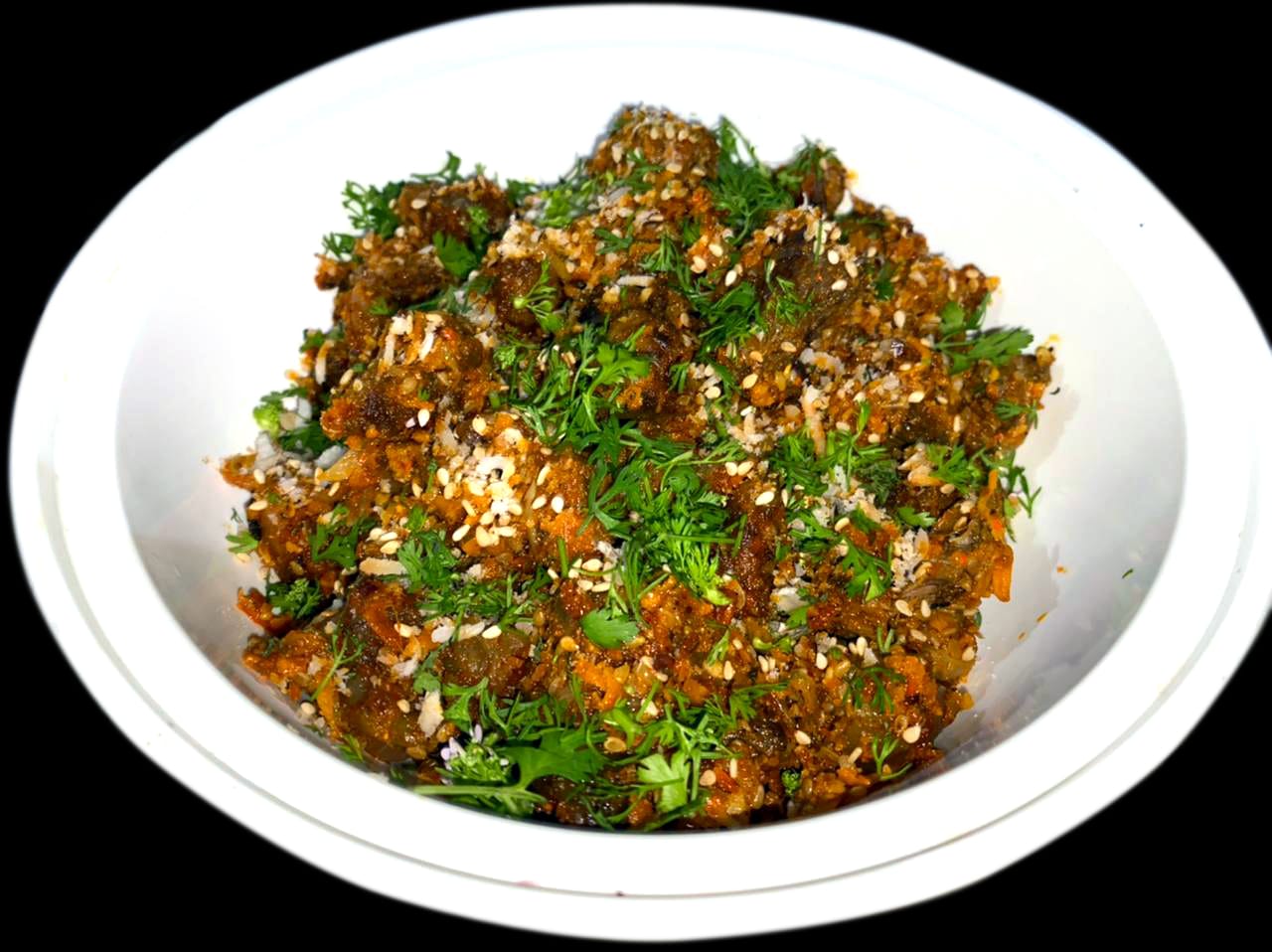
Instant Pickled Pork

Picture credit:  Sreyas Patil/Pratik Mulik

I have always enjoyed experimenting with flavours.  It is a trait my daughter, Shalvi, has inherited too!  Our family has always relished pork and I have had many successful experiments with cooking the same (and some disasters too!).  Shalvi, during one of her experiments in the kitchen, came up with this awesome recipe that I am sharing with my beloved readers today.  Happy cooking!

Ingredients:

Pork belly - 250 g

Oil - 2 tbsp

Onions - 2 large (sliced longitudinally)

Thick curd - 100 ml

Ginger-garlic paste - 2 tsp

Pickle masala - 2 tbsp  (find recipe here)

Dry coconut - 50 g (grated and mildly roasted) 

White sesame seeds - 50 g (roasted)

Turmeric - 1 tsp

Salt to taste

Lemons - 2 large and juicy

Coriander for garnishing


Time:

Prep Time:  10-15 minutes

Cook Time:    40 minutes

Seasoning:    10 minutes


Method:

Chop the pork into bite-sized pieces.  Add in turmeric and salt and toss.  Cook the pork in a pressure cooker.  After the first whistle, lower the flame and let it simmer for at least 30 minutes.   Once the pressure is released, drain any of the liquid in the pork and set aside.  (Take a bite to ensure it is properly cooked).


In a pan, heat the oil. Add onions and sauté till golden.  Add in curd, pickle masala, ginger garlic paste and some salt and cook till the mixture leaves the sides.  Add in the pork and stir it till it becomes homogeneous.  Add in the grated coconut and sesame seeds (save a small amount of both for garnishing) and stir well.  Cover the pan and simmer for five minutes.  Squeeze the juice of lemons and stir.  Transfer to a bowl, garnish with sesame, grated coconut and coriander leaves and serve hot.


Tips:

  • You may use store-bought mango pickle masala
  • Do not add water to the pork pieces - it will spread its own juice - cook in a separator
  • Add in a pinch of salt to the onions; they turn golden faster this way
  • You may substitute the pork with boneless lamb meat for pickled mutton (of course, cooking time will be lesser!)
  • Always use fresh home-made ginger garlic paste to get the best flavour
  • Please note this pickle is NOT for storage, but will stay for over a week in the refrigerator.
If you liked this recipe and other posts, please do share, follow and subscribe to the blog.  

Friday, 22 January 2021

Subhas - The Man Beyond the Hero


For a Bengali, to write about Rabindranath Tagore and Subhas Chandra Bose is perhaps the most difficult thing. These iconic personalities (despite, and because of their differences), for ages, much like the Ganges River, have fed and nurtured the consciousness and ideologies of Bengal and Bengalis. It becomes even more relevant to remember them in today’s times amidst raging debates and political discourse that are – in more ways than one – redefining our religious understanding and values and confusing them with spirituality and dogma.

Reserving Tagore for another post, I am dedicating this one to the Man whose 125th birth anniversary the nation celebrates today - Subhas Chandra Bose, our very own Netaji. 

Much has been said and written about his controversial life and death already. I’m not going to reiterate all that. Because if life is a mosaic of colours, emotions, and adventures, Netaji is the quintessence of it. He is also, and more so, as he titled his unfinished autobiography, An Indian Pilgrim.

Yes, not a politician, a leader, a war hero – but a pilgrim. And in every sense of the word.

He was the man who truly chose the road not taken, leaving home, forsaking stability and luxury to undertake hardship and suffering in the pursuit of a greater goal; the man who worshipped at the altar of Bharat Mata with the same ardent passion with which he imbibed the teachings of the Bhagavad Gita (his literary companion until the very end), Shankaracharya, Sri Aurobindo and Swami Vivekananda; the man who lived by the mantra of the Rig Veda - आत्मनो मोक्षार्थम् जगत् हिताय  – bridging the gap between self-realisation and social welfare, praticising yoga and taking his school and collegemates to various religious sites and gurus, tending to people afflicted by the then-dreaded cholera, and feeling “like a criminal” at the sight of a beggar outside his home. He was the man who worshipped Durga and Kali and meditated at the Ramakrishna Mission in Singapore even while leading his army from the front. The man who believed Hinduism is the thread binding the immense diversity of his holy motherland without being blind to the shortcomings of the religion. He wrote essays on materialism only to see if someone could prove him wrong through logic and evidence, fought for his friends' right to idol worship, was moved to tears by a touching piece of music, and protected and inspired his female comrades with the instincts of a father. A man of reason and emotion, of generosity and incomparable bravery. As he described himself in a letter to his friend, Dilip Kumar Roy (March 5, 1933) - "I am sometimes a Shaiva, sometimes a Shakta and sometimes a Vaishnava."

Very little is said, however, about Netaji’s philosophy, his spirituality. The reasons are not far to seek. He hated bigotry. He hated the use and abuse of religion through public display. He didn’t see the need to speak of the God he believed in when he could live Him through his life as an Indian.

That was Netaji’s religion. And this was his India. His brand of ‘secularism’ didn’t promote non-committal uniformity, where differences cannot be spoken of and a blinkered, strait-laced point of view is adopted at convenience, to disregard and blame the past. Instead, he believed in acknowledging and respecting differences in order to rise above and make the best of them. His men, and women (Rani of Jhansi Regiment with many Tamil recruits) – Hindus, Muslims, Sikhs, Christians – dined together before marching to the battlefield to lay down their lives for their beloved Bharat Mata. They were proof of an overarching, true ‘unity’ – distinctive ‘individuals’ acting as ‘one human being' to fulfill the one noble cause that all of them believed in.

In an era when world-changing ideologies were just coming into their own– anti-colonialism, fascism, Nazism, socialism, and communism (with the true nature and full implications of some of them unknown still) – he stood as a patriot, a nationalist, whose nation extended beyond the borders of a country -- to embrace the world. There may be contradictions in this, but few saw India as he did – an India in the context of the world.

We can debate over his political strategies (including what is often misconstrued as appeasement), the diplomatic alliances he formed, the people he had to trust to help him during crises, but we cannot deny the purity of the vision he was chasing. For in the context of the difficult time he lived in and the Herculean challenges he had to conquer, he had devoted his heart, mind, and soul to that one vision – to which he ultimately sacrificed his life willingly, and with complete faith. He dreamt of a balanced India, where not only women and minorities would be empowered to be equals but where all religions coexisted in harmony and in mutual respect, where industrialization led to material progress and an appreciation of diversity and distinctive ideologies to spiritual progress.  It was his "desire that every man and woman of the country and the entire nation may, in every respect, realize Truth. In this quest, in this Sadhana, political freedom is only a means." That is how he referred to his path, as his sadhana to accomplish national freedom and ultimately attain "complete fulfillment in personal and national life." 

We are a free nation today – with the freedom of speech, the freedom to proclaim, the freedom to criticise, the freedom to dissent and be devout, but have we achieved Netaji’s ideal of freedom? Sadly, no. When liberty and libertines rule, true emancipation is only a dream that silent pilgrims dream of – where there is no need to defend or attack; where one can live one's God through his/her life, carrying forward the message of karmayogis - uniting bhakti and shakti – as their pilgrim hero did.

"The pages of Indian history teem with the undying examples of martyrs who suffered and died for the sake of their religious beliefs. They died so that India may live. And in spite of our misery and degradation, India still lives. She lives because her soul is immortal - her soul is immortal because she believes in religion...

...From the ashes of the dead past India is again rising phoenix-like to take her place among the free nations of the world, so that she may deliver her message, the message of the spirit, and thereby fulfill her mission on earth. India lives today because she still has a mission unfulfilled."

(Letter to the Chief Secretary of the erstwhile Govt. of Burma Through The Superintendent of Jails, Mandalay, dated February 16, 1926) 

(Pic Credit: Netaji Research Bureau, Calcutta/Wikipedia)


Please let us know what you thought of the post in the comments below.  And do remember to share and subscribe to leftrightthodasacenter.blogspot.com

Wednesday, 20 January 2021

Apna Time Aa Gaya -- A Team Whose Time has Come!


India retains the Border-Gavaskar Trophy, January 19, 2021

 Photo credit: Google/timesofindia.indiatimes.com

“O, what a win was there, my countrymen! Then I, and you, and all of us fell down,” on our knees and gave thanks to the cricketing Gods, as news came in of our 2-1 victory in the Border-Gavaskar series against Australia at Gabba. The Indian tri-colour is out in force (with some of the headlines going Gabbash!).  …today India won the Border-Gavaskar trophy with a 2-1 victory against Australia at Gabba.  

In these gloomy times, we cannot have enough of such good news. The last time a visiting team won against the Aussies at Gabba was in 1988, all of 32 years ago -- when Kohli apparently was 16 days old, it was a year before Sachin debuted, George Bush had won the presidential election in America, Rajiv Gandhi was Indian PM, USSR and the Berlin Wall existed, and no one had heard of Harry Potter, Viagra or the internet! Those were the days Geoff Marsh used to open for Australia, the father of Shaun Marsh and Mitchell Marsh who played in the Brisbane test in the current series (in fact, the last named was not even born then). 

On reading the headlines, I could help but recall those days when Thommo (Australia’s feared fast bowler Jeff Thomson) marked a cross on the late Chetan Chauhan’s forehead after the latter had hit him outside the off stump ….cut to Tim Paine’s sneer “See you at Gabba!” not to mention, him asking Rishabh Pant if he was available for babysitting while he took his wife out the movies! ALL OF THAT got wiped out in a single stroke on Jan 19, 2021 as India won a test series at Gabba…by a resounding 3 wickets. As they say, Victory is sweet, but revenge is sweeter! Babaji ka Thullu!!

And who were the guys who beat Australia in this mother of all wins? A bunch of rank (almost) newcomers, who were down at 36 for all out at the start of the series at Adelaide! From the pits to the pinnacle, in the space of four tests. Truly, “nothing surpasses this,” as head coach Ravi Shastri would say after India’s historic win, "Feeling defeated is one thing but giving up is not in our vocabulary.” It was the spirit behind the victory that was actually the real hero.

As one by one the more established players got hurt, the regular captain left to fulfill family obligations, “Cometh the hour, cometh the man” became the order of the day. And who were these men who scripted history?


Shubman Gill


Photo credit: Google/Hindustan Times.com
Shubman Gill (21 years old, with all of three tests behind him) for example, whose farmer father shifted with the whole family from a village in remote border areas to Mohali, in Chandigarh, when Shubman was nine years old, all because he believed his son was a gifted batsman, who would gain from exposure. 


Mohammed Siraj

Photo credit: Google/cricketnmore.com
Mohammed Siraj, the son of an autorickshaw driver in Hyderabad and house-help mother, who for years bowled barefoot at the local Idgah maidaan, who actually used to struggle to make it to practice every day on a tight budget of 70 rupees a day, and who believe-it-or-not first handled a cricket ball when he was 20. It was his father’s dream that he play a test match for India one day. Not just adversity, Siraj battled personal loss too as his father passed away at the start of the series. He was offered a return but he decided to stick on, “to fulfill my father’s dream.”   As someone said, his father must be pointing him out to the universe today, “See, that’s my son Mohammad Siraj, the Test player!”
That’s not the only parent, India must be thankful for.

Rishabh Pant

Photo credit: Google/cricfit.com
Rishabh Pant’s mother, widowed when Rishabh and his sister were still very young, recalls taking him every weekend to train at a cricket academy in Delhi via bus all the way from Roorkee in Uttarakhand. They would stay at a local gurudwara those two days and while he trained at the ground, she would cook and serve in the gurudwara kitchens as they had no money to afford a hotel stay. On Sunday night, the mother-son duo would head back for Roorkee. “I could scarcely sleep, with my heart in my mouth, the entire journey” she says, as it was very unsafe for single, unescorted women to travel in the nights, “but, I would ensure that Rishabh caught up on some sleep” on the journey into and out of Delhi. “Ma, tujhe salaam” as all of India joins him, in a salute to a mother’s courage and determination. And to think he came as a replacement for Shikhar Dhawan. 

T. Natarajan

Photo credit: Google/timesofindia.indiatimes.com

T. Natarajan (a replacement for the injured Umesh Yadav) has a rags-to-riches story that is just unbelievable. The oldest of five brothers and sisters, he was born to a powerloom worker father and a mother who ran a local food stall in Chinnapampatti 26 km from Salem, in Tamil Nadu, the nearest big town marked on a map. Until he was 11, when his talent was spotted by a local talent scout, Jayaprakash, who also ran the local village cricket enthusiast’s club, he studied at the local government school and used to play in the fields in and around his village. “But for Jayaprakash sir, I would have most likely been a coolie today,” he has no hesitation in admitting. From such humble beginnings to becoming the Yorker King, working through a grievous elbow injury, surviving a suspect bowling action and finally taking six wickets in three games in the T20 series on the current tour of Australia, becoming the first Indian cricketer to make his international debut across all three formats on the current tour, is a long journey indeed. And to think, he actually went to Australia as a net bowler, never expecting to play in an actual match.  Destiny’s child? You bet! So is his daughter, born back in India while he was bamboozling the Aussies, whom he has seen only on video.

Shardul Thakur


Photo credit: Google/in.dafanews.com

Shardul’s childhood cricket coach, Dinesh Lad, recalls he first saw Shardul when he played for his school. In a particular tournament, where he scored 78 runs and picked up 5 wickets, Lad remembers convincing him to join the school he coached. “I told his father that Shardul had a lot of talent and could play top-level cricket. His father declined saying he had his board exams, and those days they lived in Palghar. The journey from Palghar to Mumbai was 2.5 hours, impossible to travel every day. I then asked my wife if we could keep the boy at our home so he could play here in Mumbai. My wife agreed despite her initial reservations as we had a daughter the same age. And we brought him home.” Still playing school cricket, Shardul joined the Mumbai Under-15 and after that, there was no looking back.


In a dramatic turn of events, Thakur originally a part of the ODI team, was added to the test team only after Mohammed Shami got injured. Yet, he never got to play until Gabba, when Bumrah, Vihari, Jadeja and Ashwin all suffered injuries one after the other. And then, on that fateful day on January 19, from travelling in crowded local trains to calling the shots on one of the fastest pitches in the world, Thakur completed a jou    rney that is a cricketing dream. Who can say that there was no divine design behind it?


A few years ago, he had put a lot of weight. Sachin Tendulkar advised him to get a hold on his weight as he had a brilliant cricketing future ahead of him. With the same grit and determination as he showed at Gabba, he took control and lost 13 kg of weight, just in time for fortune to come knocking at his door in the form of an international debut.

Washington Sundar

Photo credit: Google/cricketcountry.com
And last but not the least, the spin bowler, Washington Sundar and a new-age, cricketing Thakur; the most unlikely saviours/heroes for India who jointly stood between India and defeat, (or should I say India and History?) in their stand for the seventh-wicket. Together, in a sensational fightback, they kept the scoreboard going under massive pressure with every single sweat-soaked, adrenaline-charged run, fuelling India’s hopes of retaining the trophy. Then chasing 328, Indians were at 183 for 6, staring at a massive deficit. “Steel running through their nerves” they showed incredible character.


Debutant Sundar’s father reveals the mystery behind his son’s very unusual name. Sundar senior was a Ranji trophy player in his youth. “I was too poor to support my playing ambitions, but an ex-army man by the name of PD Washington would buy my uniform, pay my school fees, my books, even take me to the ground on his cycle, and encourage me endlessly. When my son was born in 1999, Washington sir had already passed away. I decided to name my son after him.” 

Photo credit: Google/India.com

However, there is yet another thread that connects the brilliant achievements of this young team with “steel running through their veins,” and that is Rahul Dravid, who heads India’s National Cricket Academy, Bangalore. Many credited the inspired performances by ‘young uns’ like Pant, Sundar and Gill, to Dravid who had groomed them at the Under-19 level. 

In the words of a Twitterati, ‘he will smile his silent smile and go back to training tomorrow morning.” As will all the physios, the bowling and batting coaches, the practice pitch-incharges and the countless, nameless others who are no less responsible for this glowing triumph, now etched in history for all times to come.

So what’s in store for the “Class of 2021”? If India’s cricketing history is anything to go by, impossibly heightened expectations, with riches untold, are all lying in wait for the battered and bruised warriors when they return to Indian shores from Down Under. Dealing with these will involve another test of character, played out on a pitch more damning and unforgiving than the pitches they played so valiantly in Australia. The England tour coming ahead will decide many of their futures.
  But for now, they are up there on the cricketing skies as the guiding stars of Indian cricket. Who knows how many players of the future were born the minute Rahane, held the Border-Gavaskar trophy aloft – only time will tell. 


It seems as if the poet knew of all these bravehearts when he wrote these words for the song “Dil ka haal sune dilwala/Seedhi si baat na mirch masala” (Shri 420)


Chote se ghar mein gareeb ka beta

Main bhi hoon ma ke naseeb ka beta

Ranj-o-gham bachpan ke saathi

Aandhiyon mein jali jeevan baati

Bhookh ne hai bade pyaar se paala


“There is a tide in the affairs of men/Which, taken at the flood, leads on to fortune.” wrote Shakespeare.  And these then, were the “few good men” who helped turn the tide and lead their side to “good fortune.” In the words, of the stand-in captain (who himself came to the post in a twist of fate) the victory belonged to the entire team that showed “great character and fighting spirit on the field.”

So what did you think of leftrightthodasacenter.blogspot.com 's first post on sports?   Do comment in the section below and let us know -- and of course, don't forget to like share and subscribe!

Monday, 18 January 2021

Pickle Masala Powder


Indian cuisine is known for its perfect blend of spices which can give our taste buds a near orgasmic experience! Particularly, if you are into experimenting with flavours just like me, you can find a variety of dishes where the same spicy mixtures can be incorporated to create surprisingly delicious results. Presenting one such recipe which is traditionally used for pickling raw mangoes in summer which you can have a great time experimenting with.  Happy cooking!

Ingredients:

  • Turmeric powder (haldi) - 2 teaspoons
  • Powdered asafoetida (hing) - 1 teaspoon 
  • Fenugreek seeds (methi) - 1 tablespoon 
  • Mustard - 3 tablespoons  
  • Red chilli powder - 3 tablespoons 
  • Onion nigella Seeds (kalonji) - 1 tablespoon 
  • Fennel seeds (saunf) - 1 tablespoon 
  • Coriander seeds (dhania) - 2 tablespoons


Method:

  • In a pan, dry roast the fenugreek seeds till  they turn light golden.  Transfer to a plate and set aside to cool
  • Similarly, one by one, using the same pan, dry roast fennel (until it turns aromatic), the kalonji (till just warm) and the coriander seeds (until light golden) and transfer to the same plate
  • Once all of the above have cooled down, add the turmeric, chili powder, asafetida, and mustard and grind to a coarse powder in a mixer grinder
  • Store in an air-tight container for future use

Tip:

This spice mix tastes best with acidic foods

Friday, 15 January 2021

Tilache laddoo


After reading my post on Makara Sankranti, my sister-in-law, Sarita sent me a picture of the sesame laddoos she had made.  I asked her to share the recipe too.  She did, and here's me sharing the recipe with all of my beloved readers!


Ingredients:

1 cup white sesame seeds

½ cup groundnut seeds

½ cup sugar

1 tbsp ghee


Preparation Time:  

None


Cooking Time:  

10-15 minutes


Time to Make the Laddoos:  

Depends on your skill level!


Method:  

In a pan, dry roast the sesame seeds on a low-to-medium flame, until they splutter.  Set aside to cool.  In the same pan, still keeping the flame at low to medium, dry roast the groundnut seeds till they turn aromatic.  Once they cool, de-husk and grind them finely with the roasted sesame and sugar in a mixer grinder.  In a bowl, add one tablespoon ghee to the ground mixture and make small, ball-shaped laddoos.


My Tips:

  • Substitute the sugar with jaggery powder to relish an actual til-gul laddoo!
  • Grease your palms with a little ghee while making the laddoo


This is a super easy, no-fuss recipe.  Do try it out and share the results of your trial (including pictures) in the comments section.


Sarita is a great cook.  I have asked her to share the recipes of some of her yummy, not-so-common dishes that she keeps treating us to.  Do keep an eye out for the label  "Sarita Vanjari" the next time you visit this blog.


If you liked this recipe and other posts, please do share and subscribe to the blog.

Thursday, 14 January 2021

Cheesy Chicken Balls

Today, on Kinkrant, we planned on chicken for dinner.  My family challenged me to make something I had never made at home before.  We had recently eaten cheesy potato balls in Dominos and I decided to make something similar.  The Chicken Cheesy balls turned out to be a superhit with my family!  Sharing the same here.

Time

Prep time 15-20 minutes.  Cook time 10-15 minutes.  Eating time 2 seconds (they just disappear as they come out of the pan!)

Ingredients

Boneless chicken 250 g
Green Chillies  1-2
Ginger 1" piece
Garlic 6 cloves (peeled)
Oregano/mixed herbs 1/2 tsp (optional)
Shredded Mozzarella cheese 200 g (I used Amul pre-shredded cheese)
Bread crumbs 1 cup
Maida/all-purpose flour 1/2 cup
Oil for deep frying
Salt to taste

Procedure

Make a paste of ginger, garlic, and green chili in a mixer/grinder (do not add water).  Mince the boneless chicken in the mixer grinder (will get a dough-like consistency).  To the minced chicken, add salt, mixed herbs, ginger/garlic/chili paste and knead well till uniformly mixed.  Take a small ball of the mincemeat mixture and flatten it on your palm.  Place a generous amount of cheese on it and wrap it up in the chicken and roll slightly to get a uniformly shaped roll.  Make all rolls and set aside.  In a bowl make a paste of the all-purpose flour with water.  Heat oil in a pan.  Dip each ball in the flour paste, roll it in bread crumbs and deep fry till golden brown.  Serve piping hot with tomato ketchup or green chutney dip.

Do try it out and share the results of your trial (including pictures) in the comments section.

If you liked the recipe and other posts, please do share and subscribe to the blog.


Tips:

  • If you like it spicy, you can add some pepper powder to the minced meat.
  • Grease your palms with a little oil while making the balls.
  • The all-purpose flour paste should not be too thick in consistency, should only have a thin coat of the same on the balls.

Green Chutney Dip


Description

An ideal accompaniment for most Indian starters, the green chutney is also used as a base for sandwiches.  Easy to make and high on nutritional value, this chutney can be stored in the refrigerator for over a week.

Ingredients

Mint leaves - 1/2 cup
Coriander - 1/2 cup
Garlic - 6-8 cloves
Ginger - 1 inch
Green Chili -  2-3 (depending on how spicy you like your dip to be)
Juice of half a lemon
A pinch of sugar
Salt to taste

Time

Prep time, less than 10 minutes.  Cook time, Zero.

Procedure

Finely grind all the ingredients in a mixer/grinder with minimal water.  Your chutney dip is ready to be savoured.


Tips

  • The chutney should be of thick, flowing consistency.
  • Wash all ingredients except garlic before grinding.
  • When washing any vegetable, preferably wash in a bowl of water to which tiny amount of potash alum has been added.  The potash alum will aid in making soil separate from the vegetables and settle in the bottom.
  • Finally, last but not the least, the sugar balances out the salt in a savoury dish just as salt balances the sugar in a sweet dish.